

From experiment to impact: How leaders can build trust and ROI in AI super agents
Enterprise AI will scale or stall based on three factors: leadership conviction, enterprise-grade trust and measurable business impact.


The conversation has shifted from AI adoption to enterprise-wide impact and delivery.
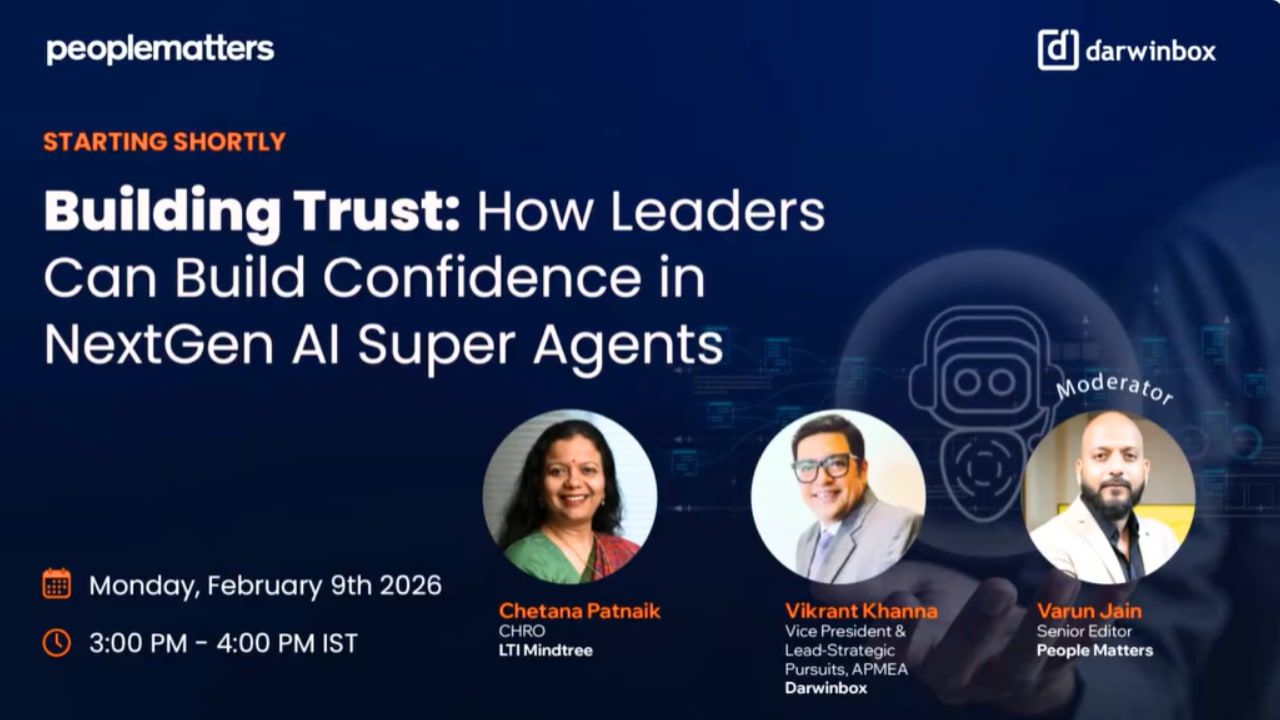
This shift was defined in a recent LinkedIn Live hosted by People Matters in collaboration with Darwinbox, where leaders argued that enterprise AI must now prove its value in productivity gains, decision velocity, and talent outcomes. Trust, ownership beyond HR and measurable ROI will determine whether AI becomes embedded infrastructure or remains an underused tool.
The discussion, led by People Matters Senior Editor Varun Jain, brought together Chetana Patnaik, CHRO, LTI Mindtree, and Vikrant Khanna, Vice President and Lead – Strategic Pursuits, APMEA, Darwinbox. The message was clear: AI adoption is no longer experimental, and its success hinges on trust, mindset shifts and demonstrable business outcomes.
AI adoption is a business imperative, not an experiment
The conversation has clearly moved beyond pilots and proofs of concept. “The phase of experimentation is already over,” said Patnaik. “It is the time and the year to measure the outcome. Boards and business leaders are looking at productivity.”
While experimentation continues, she stressed that organisations must now focus on performance and measurable results. “While experimenting, you have to perform and focus on outcomes. That is the need of the business.”
Khanna echoed the urgency. “AI is there, and the sooner organisations accept it, the better,” he said, adding that leadership must drive adoption decisively rather than cautiously.
Trust in AI: Predictability, privacy and accountability
Trust emerged as the defining theme of the session. Khanna outlined enterprise trust parameters: predictability of responses, data privacy, bias mitigation, explainability and compliance with applicable regulations.
“In an enterprise, you want consistency and predictability of answers,” he said. Unlike consumer AI tools, enterprise systems must deliver stable, contextual responses aligned with regulatory requirements. “Data residency, use of third-party models — these are valid concerns enterprises have today.”
He emphasised explainability. “When a response comes, it’s important to know the rationale behind that response.”
Patnaik defined trust as confidence in reliable delivery. “If people are using it and it delivers accurate and reliable results, operates transparently and swiftly, and functions within a framework where humans retain oversight, that builds trust,” she said. Repeated positive experiences, she added, increase acceptance.
ROI: Productivity unlock and business value
With AI investments rising, how are HR leaders justifying returns?
Khanna structured ROI around four dimensions:
- Operational efficiency: Reducing process cycle times, minimising data errors and lowering query burdens.
- Better, faster decisions: Enabling leaders to query data directly rather than relying on manual reporting.
- Employee experience and manager productivity: Empowering employees with self-service tools.
- Talent outcomes: Faster hiring, improved retention and better talent matching.
“Eventually, it boils down to how many productive hours you are adding to the organisation,” Khanna said. He noted that well-implemented AI deployments can unlock between 1.8% and 2.5% productivity gains. “That is significant.”
Organisations can translate that into improved revenue per FTE, EBITDA per FTE or cost avoidance, he added.
Patnaik summarised the impact as “more impactful work with less time, no repetitive work and expansion of bandwidth.”
Leadership responsibility extends beyond HR
Although AI adoption often spotlights the people’s function, Patnaik cautioned against confining ownership to HR.
“Responsibility and ownership should be with everybody in the organisation who is holding the role of a leader or a manager,” she said. “One function cannot do it. The speed is so high that depending on one function is not going to work. Everybody has to chip in.”
Khanna clarified that while leadership across functions must drive AI adoption, people platforms naturally draw attention because they touch every employee. “People platforms are all-pervasive. That impact is felt across the organisation.”
From curiosity to embedded AI: LTI Mindtree’s journey
During the session, Patnaik detailed how LTI Mindtree moved from AI curiosity to enterprise-wide integration.
“We didn’t want AI to become a buzzword. We wanted to get our hands wet,” she said.
In mid-2024, the company launched a “reimagining HR” initiative aimed at embedding AI across the hire-to-retire lifecycle. One early outcome was Raima, an AI-powered super agent that provides employees instant answers to HR queries.
“Things that used to take time and run back and forth are available on fingertips,” she said.
AI tools were subsequently introduced across talent acquisition, performance management, onboarding, HR services and alumni engagement, supported by the company’s internal BlueVerse AI ecosystem, which is a library of pre-built agents and a no-code builder that accelerated deployment.
The five levels of AI maturity
The following maturity curve is often observed among organisations, Khanna shared, which includes:
- Content and creativity use cases
- Operational efficiency improvements
- Enhanced employee experience through contextual agents
- Agent orchestration for talent intelligence
- Business intelligence applications
“One of the biggest impacts we’re seeing is a significant reduction in searchability or findability time,” he said. Time saved enables HR and managers to focus on “relationship building and strategic thinking”.
Mindset shift: Replacing tasks with AI, not humans
Addressing workforce concerns, Patnaik emphasised communication and psychological safety.
“The biggest one leaders need to deal with is creating confidence that it’s not here to replace humans,” she said. “It is there to replace transactional tasks, not jobs or roles.”
She stressed that the human element remains central to organisational success. “The human touch will remain irreplaceable.”
Within HR at LTI Mindtree, she reported minimal resistance and strong adoption of AI copilots.
Khanna framed the broader shift as cultural rather than procedural. “Change does not need to be managed. Change needs to be accepted,” he said, challenging the notion of “change fatigue”.
The road ahead: Technology side by side with people
Looking two to three years ahead, both leaders envisioned deeper collaboration between humans and AI.
Patnaik predicted that digital agents will handle repetitive, multi-step administrative tasks, while humans focus on creativity, empathy, culture-building and developmental conversations.
Khanna described the future as “people plus technology collaboration,” where human-to-human interaction becomes more meaningful as routine work is automated.
AI super agents promise efficiency and seamless workflows, but their long-term impact will depend on leadership conviction, measurable ROI and sustained trust. The technology is advancing rapidly. The real differentiator will be whether organisations embed confidence in the systems, the safeguards and the human-AI partnership shaping the future of work.
Branded Content Team
The People Matters Branded Content Team crafts compelling, insights-driven content that connects brands with audiences, drives engagement, and drives meaningful business outcomes.


